Canadian Military Pattern (CMP)Truck
The Canadian Military Pattern (CMP) truck was one of Canada's most important contributions to victory in the Second World War. By September 1945, Canada had produced roughly 850,000 vehicles for the Allies, 410,000 of which were CMP trucks. There are many ways that you can customize your 1/48 scale CMP truck, but here is a quick video with a few ideas: North African CMP FAT

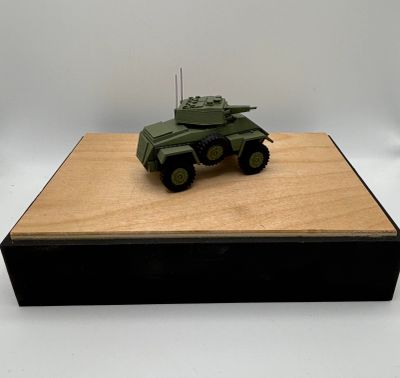
Fox Armoured Car
The Fox Armoured Car was a Canadian-made adaptation of the British Humber Armoured Car. The Canadian vehicle was adapted to fit onto the chassis of a Canadian Military Pattern (CMP) truck and was manufactured in Oshawa, Ontario. Typically, the Fox operated on roads; however, it had excellent off-road capabilities. The Fox carried a crew of four and was armed with a .50 and .30 calibre machine guns.
The Canadian Tank Museum in Oshawa houses one of the few remaining operational Fox Armoured Cars, which itself is a combat veteran of the Italian Campaign.
See the Fox in the Marathon of History Store!
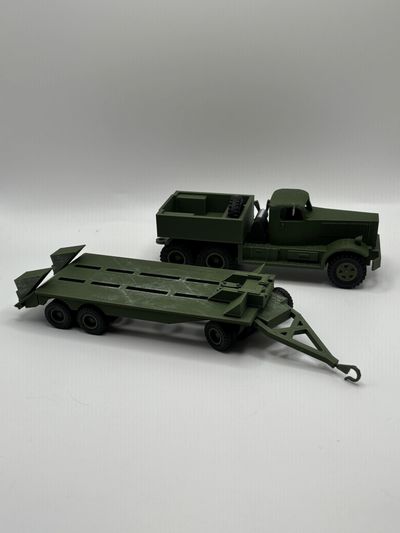
M-19 Diamond T 45-ton tank transporter
Like many vehicles that became mainstays in the arsenals of the Canadian and British Armies during the Second World War, the Diamond T 40-ton tank transporter was born out of necessity and desperation.
Between the First and Second World Wars, deciding the best use for armoured fighting vehicles was a somewhat overlooked area with many schools of thought unable to reach a consensus. The movement of tanks from their places of manufacture to the front was given even less thought. It wasn’t until 1937 that the British Army placed its first orders for what would prove to be the woefully under-strength Scammell 20-ton transporters. These vehicles were able to handle the smaller British armour of the era, including the Valentine and Matilda tanks; however, this would only prove sufficient until the larger cruiser and medium tanks began to appear.
With the British Army having lost the majority of its vehicles in the disastrous 1940 France campaign, there were very few domestic options to replace equipment. To remedy this, Britain established the British Purchasing Commission to the United States to procure vehicles under the provisions of the 1939 American Neutrality Act that allowed American manufacturers to sell to Britain and France.
Tenders for tank transporter designs were distributed to many prominent American vehicle manufacturers, including White, LaFrance, Mack, and Diamond T, among others. The result was that the Diamond T design was picked as it offered many advantages to the British Army. These advantages included the undeniable power of the Hercules Diesel engine and the tight turning radius for the narrow British roads provided by the drawbar trailer.
Production began in 1941, with many models being delivered directly to the famed Desert Rats of the British 8th Army in North Africa. Other units went to England where they equipped armoured transportation formations preparing for the invasion of Europe. The Diamond T was produced in two variants: the 980 and the 981. The most significant difference between the two was the placement and mechanics of a front-mounted winch on the 981 version.
In all, the British Army was supplied with 2,000 units of the Diamond T, the Canadian Army with 677, and 471 went to the Red Army. This figure includes both the 980 and 981 variants. The Diamond T tank transporter saw service in many Canadian units in both the Italian and Northwestern Europe theatres, as well as in the post-war military.